Board Games
A board game compresses a set of decisions into a box: a board or cards, pieces, and a rulebook that defines what a turn can do. The oldest still-played examples predate the printing press.
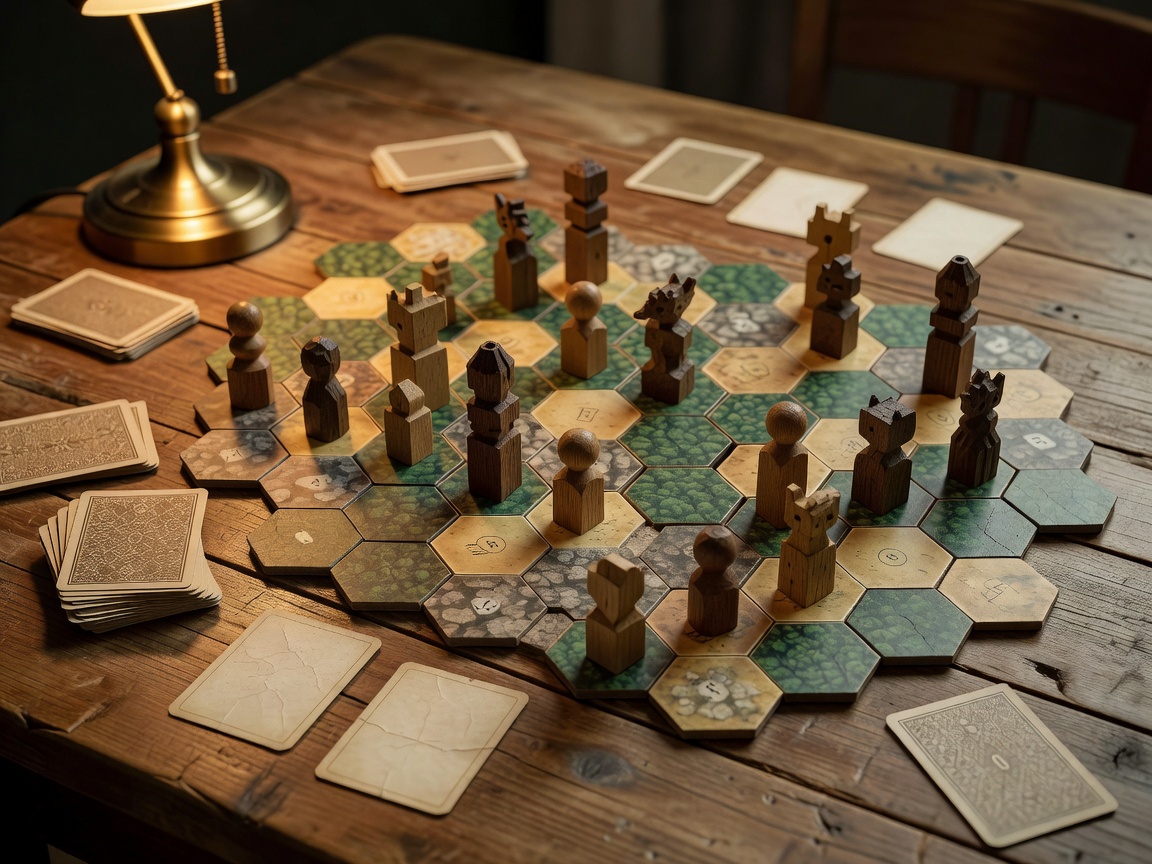
Two long histories
Chess is played on a fixed board with fixed pieces and no hidden information: both players see the entire position at all times, and the game is pure calculation against an opponent's plan. Go uses far fewer rules — place a stone, capture by surrounding — on a larger grid, and produces a decision space wide enough that it remains a subject of serious study. Both are abstract strategy games: no theme, no luck, no cards. Between them they represent the oldest continuously played board game tradition still active today.
The modern board game
Post-war German board game design, often called the Eurogame style, favoured indirect competition, modest luck, and rules that could be explained in a few minutes — Klaus Teuber's Catan, first published by Kosmos, is the standard reference point for the style: players trade and build rather than attack each other directly. American-style design tends toward direct conflict and heavier theme. Ticket to Ride, designed by Alan R. Moon and published by Days of Wonder, sits closer to the Eurogame side of that line — route-building on a fixed map with simple turn structure and a wide playable age range. Pandemic, designed by Matt Leacock and published by Z-Man Games, introduced cooperative play to a mainstream audience: every player wins or loses together against the board itself, rather than against each other.
Mechanics worth knowing before buying
- Worker placement
- A limited number of action spots exist each round; players compete to claim them before opponents do.
- Deck-building
- Players start with a weak deck of cards and add stronger ones as the game progresses, changing their options round to round.
- Area control
- Board space itself is the resource being contested, rather than cards or resources held off the board.
- Hidden information
- Some or all of a player's position is concealed from opponents, as in a hand of cards rather than an open chess board.
Choosing a game for a group
The player count printed on the box is a hard limit set by the physical components and balance of the design, not a suggestion — a game built around a two-player dynamic rarely scales cleanly to five. Rules overhead matters more for a first game with a mixed or new group than box size or theme does: a rulebook that takes under fifteen minutes to explain gets a group actually playing, where a longer one risks losing interest before the first turn. Replayability tends to come from variable setup — modular boards, shuffled card pools, different starting positions — rather than from how large or elaborate the box itself looks on a shelf.
Getting started
Read the rules aloud once, in full, before the first turn rather than mid-game when a dispute comes up. Play the simplest scenario a rulebook offers first, not an advanced variant printed on the back page for later. A group's first game together decides, more than any other factor, whether there's a second — a smooth, well-explained first play of a middling game beats a badly explained first play of an excellent one.