Puzzling
A jigsaw puzzle is a picture cut into interlocking pieces, then reassembled by hand. No screen, no timer unless one is set deliberately, no result but the finished image.
How a puzzle is built
Two construction methods dominate. Cardboard puzzles start as a printed sheet laminated to greyboard, then die-cut in a single press stroke — manufacturers such as Ravensburger and Eurographics run this process at scale, which keeps cost per piece low. Wood puzzles are blade-cut, usually one at a time or in small batches, and often include figural pieces shaped like recognisable objects rather than the interlocking tabs of a cardboard cut. That hand process is why wood costs more per piece and why a wood puzzle rarely exceeds a few hundred pieces.
Piece count runs from around 100 for a children's set through the common 500 and 1,000-piece range, up to panoramas that pass 5,000 pieces. Some specialty releases run into the tens of thousands and are built for group assembly over weeks rather than a single sitting. Piece count alone doesn't set difficulty — a low-contrast image at 1,000 pieces takes longer than a bright, high-contrast image at the same count, because sorting depends on being able to tell pieces apart.
Cut style and image
Most modern cardboard puzzles use a random cut: no two pieces share an identical shape, and rows don't repeat. Older ribbon-cut puzzles used a repeating pattern along each row, which some collectors still seek out for the era it represents. Premium cuts sometimes include a small number of "whimsy" pieces shaped like animals or tools, scattered through the image as a finishing touch rather than a functional feature.
Board finish matters more than most buyers expect. A glossy print shows glare under lamp light and can make a puzzle harder to read in the evening, which is when most puzzling actually happens. A matte finish costs little extra and solves that problem outright.
Piece count and image at a glance
- Under 300
- Suited to children or a first attempt; large pieces, thick board, short sitting.
- 500–1,000
- The common range for an evening-to-weekend puzzle; widest choice of image and brand.
- 1,500–3,000
- A multi-week project; needs a dedicated surface that won't be disturbed between sessions.
- 5,000 and above
- A long-term, often shared project; usually finished on a puzzle mat or board that can be rolled or stacked.
Competitive puzzling
Puzzling has a competitive side most casual buyers never encounter. The World Jigsaw Puzzle Championship brings solo, pairs and team competitors together to assemble identical puzzles against the clock, with the same brand and image given to every competitor to keep the comparison fair. It sits closer to a timed sport than a hobby fair, and it has shaped how some manufacturers cut puzzles intended for speed assembly, with cleaner random cuts and less ambiguous colour blocking.
Choosing a puzzle
Match piece count to the time actually available, not the time hoped for — an unfinished 2,000-piece puzzle taking up a table for a month teaches most people to buy smaller next time. Check whether the image has large flat colour fields (sky, water, a plain wall); these are consistently the hardest part of any puzzle regardless of piece count, because there's little visual information to sort by. Buy a board or mat if the puzzle won't be finished in one sitting; puzzles left loose on a table get disturbed, and a partly finished 1,000-piece puzzle is hard to preserve without one.
Getting started
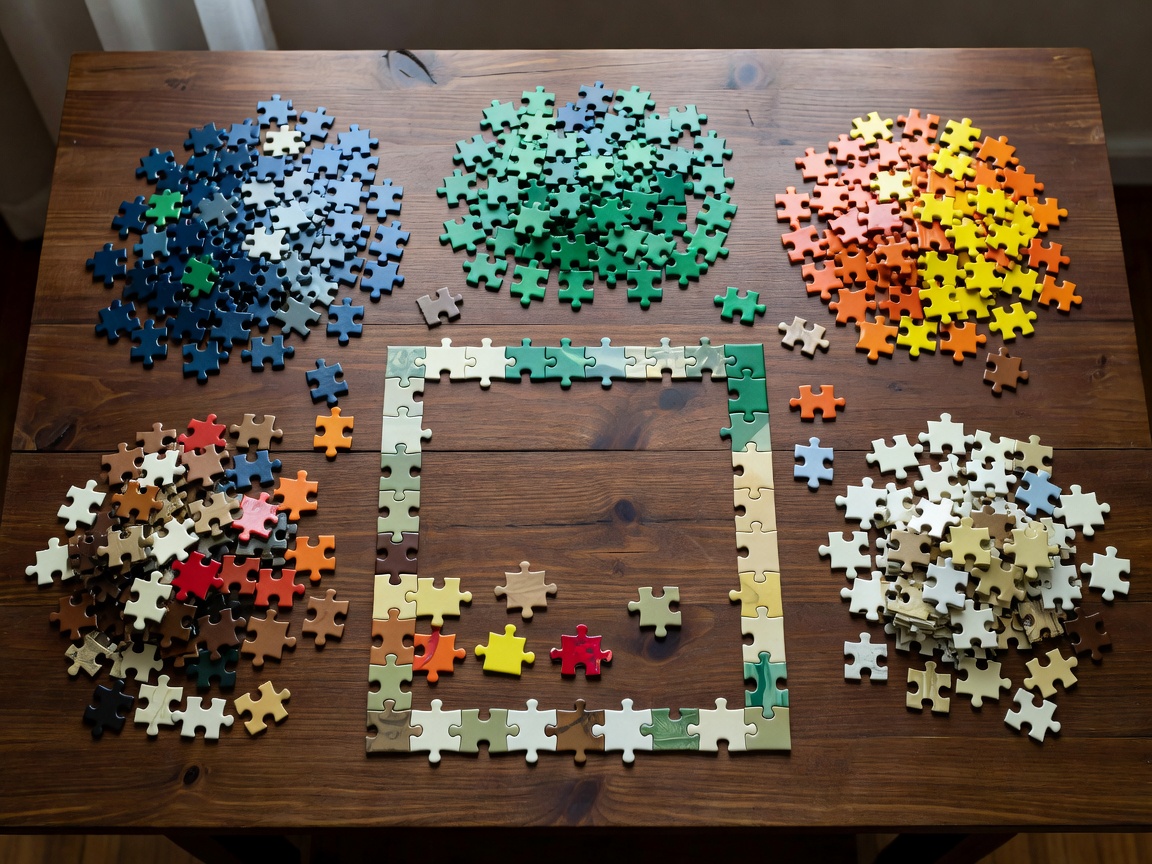
Pick a lower piece count first — 500 rather than 1,500 — until the pace of sorting and fitting becomes familiar. Sort edges before anything else; a complete frame gives every interior piece two fixed reference points instead of none. Group interior pieces by colour block rather than by shape, since shape repeats far more than colour across a large puzzle. Work in short sessions rather than one long sitting — puzzling tires the eyes well before it tires the patience, and a fresh look the next day finds pieces a tired one misses.